Field notes
The Best Soil for Raised Bed Gardening (and How Much You Need)
The best soil for raised bed gardening is a blend of topsoil and compost. Get the exact ratios, how to prepare and fill a bed, and how much soil you need.
TL;DR
- The best soil for a raised bed is a blend of quality topsoil and compost, roughly two thirds topsoil to one third compost, and never more than half compost.
- On a hard surface like a patio or deck, swap the topsoil for a soilless growing mix and keep a 1:1 ratio with compost.
- Aim for loose, free-draining soil with 25 to 50 percent organic matter, at least 8 to 12 inches (20 to 30 cm) deep.
- To work out how much you need, multiply length by width by depth in feet. A 4 by 8 foot bed at 12 inches takes about 32 cubic feet, a little over one cubic yard.
- Top up with an inch or two of compost every season instead of replacing the soil.
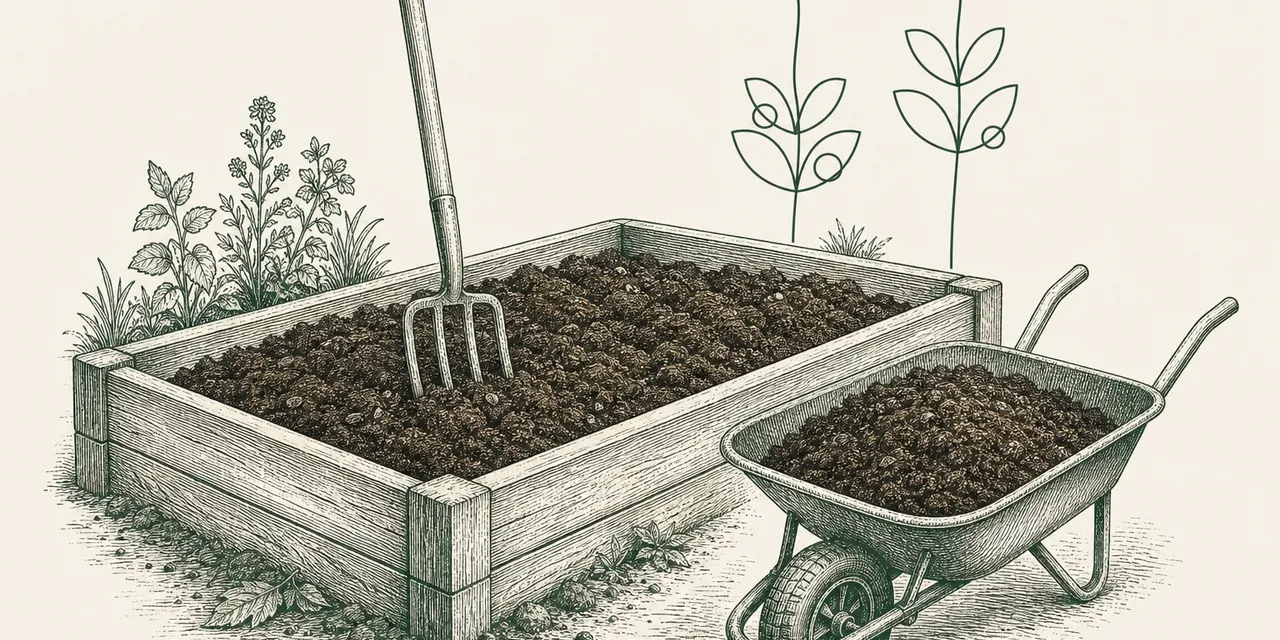
The best soil for raised bed gardening is a blend of quality topsoil and compost, not bagged “raised bed mix” on its own and not the native dirt already in your yard. Get the soil right and the bed does most of the work for you: roots run deep, water drains instead of pooling, and plants shrug off the dry spells that kill them in poor ground. This guide gives you the exact mix ratios, the best soil for growing vegetables, how to prepare and fill a new bed, and how to calculate how much soil you actually need.
What is the best soil for raised bed gardening?
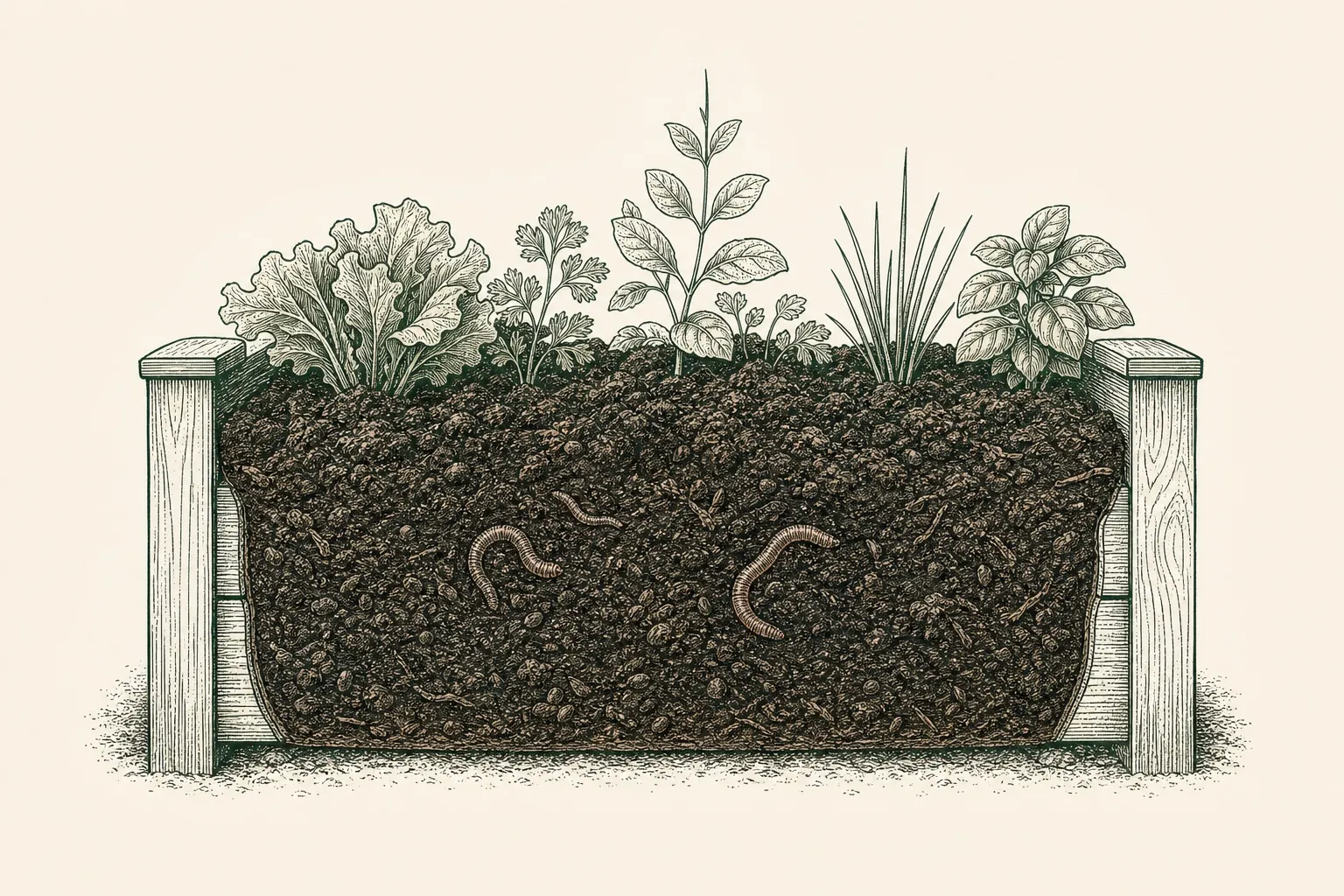
The best soil for raised bed gardening is a loose, fertile blend of topsoil and compost. Topsoil gives the bed body and holds moisture. Compost feeds the soil life and supplies nutrients. Together they make a free-draining home for roots that you control from the start.
The exact ratio is forgiving. The University of Minnesota suggests a mix of topsoil and compost at roughly two thirds to one half topsoil and one third to one half compost. Penn State recommends a simpler 70/30 blend of good-quality soil to compost. Both land in the same place: mostly soil, with enough compost to stay rich and open.
One number to anchor on is organic matter. The University of Maryland recommends raised bed soil hold 25 to 50 percent organic matter by volume. That range is your guardrail: enough compost to feed the bed, not so much that it behaves like pure compost.
Should you use native soil, potting mix, or a blend?
Use a blend, not native soil or potting mix alone. Each one fails on its own for a different reason.
Native soil, especially heavy clay, compacts and drains poorly, which is the exact problem a raised bed is meant to solve. The RHS notes that part of the point of a raised bed is filling it with a free-draining mix you choose, rather than fighting whatever is in the ground.
Bagged potting or “raised bed” mix alone has the opposite problem. It is light and peat- or coir-based, so it dries out fast and is expensive to buy by the cubic yard. Pure compost is too rich and holds too much water once it settles. The blend exists because topsoil and compost cover each other’s weaknesses.
The best soil mix recipes for raised beds
Here are three reliable mixes, depending on where your bed sits. All are measured by volume, so “parts” can be buckets, bags, or wheelbarrows.
| Situation | Mix | Notes |
|---|---|---|
| Standard bed on soil | 2 parts topsoil : 1 part compost | The everyday blend: mostly topsoil, enough compost to enrich it. |
| Richer vegetable bed | 1 part topsoil : 1 part compost | More compost for hungry crops, still within the 50 percent ceiling. |
| Bed on a hard surface | 1 part soilless mix : 1 part compost | Use when the bed sits on patio, deck, or driveway. |
For a bed standing on a hard surface, the University of Maryland recommends compost and a soilless growing mix in a 1:1 ratio, because there is no ground soil underneath to draw from. If your topsoil is very heavy clay, stir in some coarse sand to loosen the texture.
What is the best soil for raised bed vegetable gardening?
The best soil for raised bed vegetable gardening is the same topsoil-and-compost blend, kept loose, deep, and rich in organic matter. Vegetables are hungry and thirsty, so they reward a bed that holds moisture without going soggy.
Depth matters as much as the mix. The University of Maryland suggests a minimum depth of 8 inches for leafy greens, beans, and cucumbers, and 12 to 24 inches for peppers, tomatoes, and squash. The RHS puts the root depth for deeper crops at 45 cm (18 in) or more. Build deeper than you think you need and no crop will run out of room.
If you are still planning what to plant, our guide to raised bed vegetables covers the easiest crops to start with.
How much soil do you need to fill a raised bed?
To find how much soil you need, multiply the bed’s length by its width by its depth, all in feet, to get cubic feet. Divide by 27 to convert to cubic yards, which is how bulk soil is usually sold.
A worked example: a 4 by 8 foot bed filled to 12 inches is 4 x 8 x 1 = 32 cubic feet, or about 1.2 cubic yards. Here is the math for common bed sizes at a 12-inch (30 cm) depth:
| Bed size | Depth | Soil needed |
|---|---|---|
| 4 x 4 ft | 12 in | 16 cu ft (0.6 cu yd) |
| 3 x 6 ft | 12 in | 18 cu ft (0.7 cu yd) |
| 4 x 8 ft | 12 in | 32 cu ft (1.2 cu yd) |
| 4 x 8 ft | 6 in | 16 cu ft (0.6 cu yd) |
Once you have two beds or more, bulk soil delivered by the cubic yard is far cheaper than bags. Order about 10 percent extra, because fresh soil settles after the first few waterings.
How do you prepare the best soil for raised bed gardening?
Preparing the soil for a raised bed takes four steps and an afternoon. Do it once and the bed is ready to plant the same day.
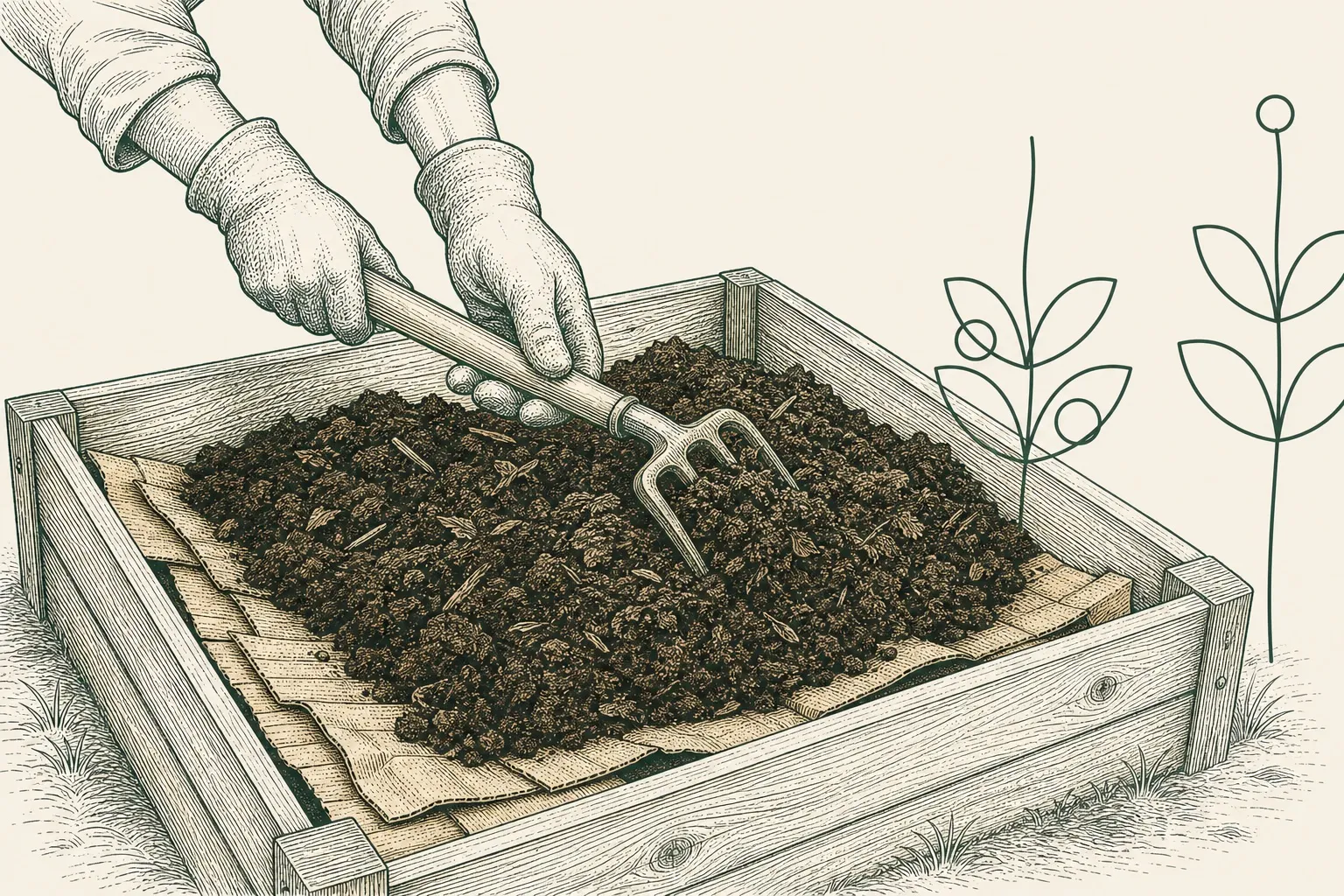
- Clear the base. Lay cardboard over grass or weeds inside the frame to smother them. It breaks down over a few months and lets roots reach the ground below.
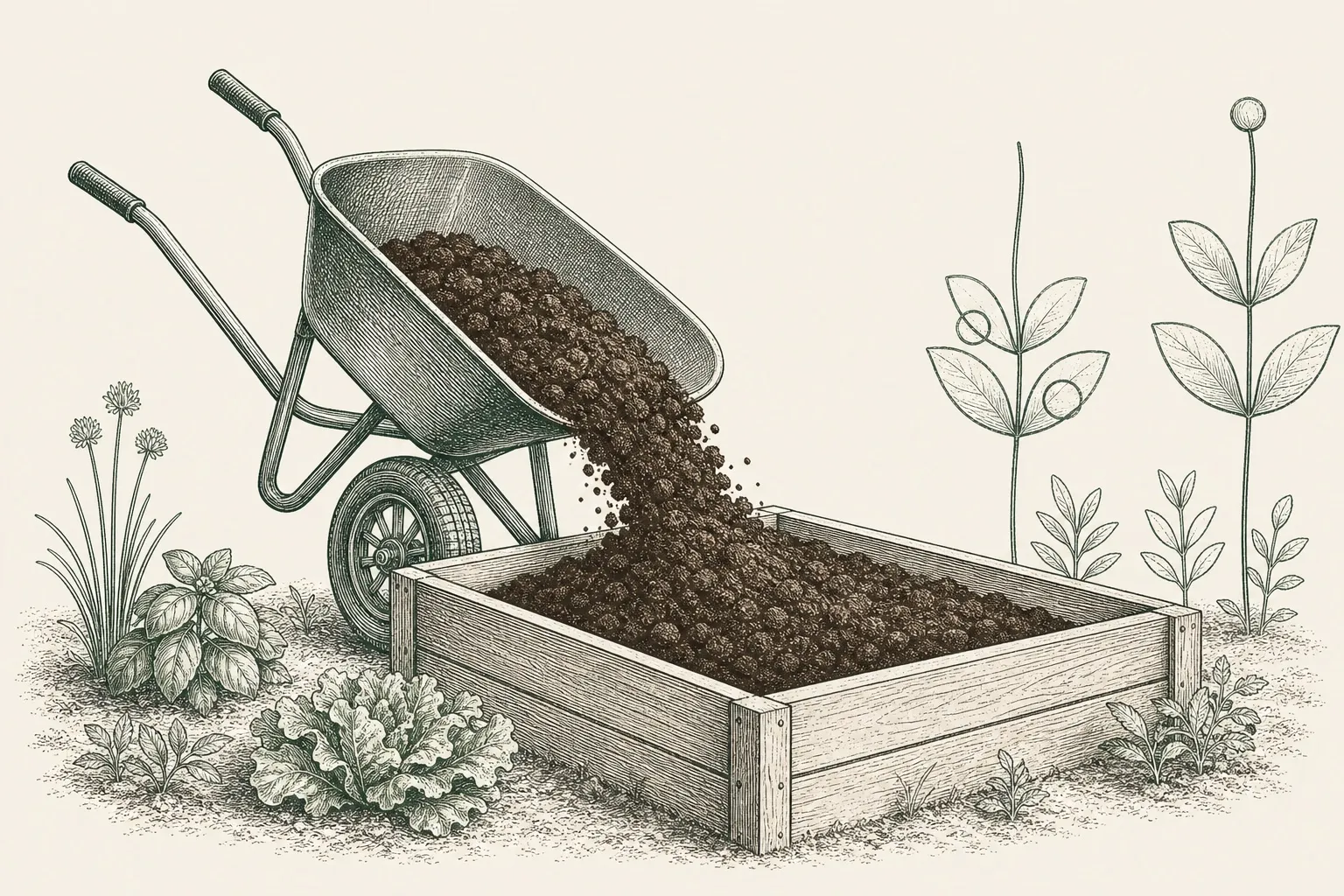
- Mix your blend. Combine topsoil and compost to your chosen ratio, either in a wheelbarrow or directly in the bed, turning it with a fork until it is even.
- Fill and level. Fill to about an inch below the rim, then rake it flat. Do not firm it down hard, because roots want it loose.
- Water and settle. Soak the bed once and let it stand a day. Top up any low spots before planting.
Skip the popular trick of filling the bottom third with logs and branches for your first bed. It sinks as it rots, and beginners often find a half-empty bed by midsummer. Start with good soil all the way down.
How do you keep raised bed soil healthy each year?
Keep raised bed soil healthy by topping it up, not digging it over. Each season, spread an inch or two of compost on the surface and let the worms work it in.
Penn State’s advice is to keep the soil covered with mulch and compost, which protects soil life and slows moisture loss. Because you never walk on a raised bed, the soil stays loose, so you rarely need to dig. Pull weeds while they are small and keep something growing or mulched on the surface.
Resist the urge to pile on compost every few weeks. Past the half-and-half mark you tip into the problems of pure compost: it holds too much water and can lock up nutrients. A steady inch or two a year is plenty.
Soil safety: lead and contaminated fill
One safety check is worth doing before you fill a bed, especially in a city or near an old house. Avoid “fill dirt” of unknown origin, which can carry construction debris or contaminants.
If you are reusing ground soil or gardening near old paint or a busy road, a basic soil test is cheap insurance. The University of Maryland warns against planting food crops in soil with a total lead level over 400 ppm. When in doubt, build on a barrier and fill with fresh, sourced soil instead.
Your raised bed gardening soil checklist
The best soil for raised bed gardening is not complicated: mostly topsoil, a third to a half compost, loose, deep, and free-draining. Get that blend right, fill to the correct depth for what you grow, and top up with compost each season.
If you are building the bed itself, our beginner’s guide walks through sizes and construction, and you can browse the rest of our growing guides for what to plant next. Start with one well-filled bed. Good soil is the one investment that pays off every season.